
There is a leader in almost every room who sees things others do not. They cut through complexity quickly. They spot the flaw in the plan before anyone else has finished reading it. They stay calm when others get reactive and they are almost always right.
And yet something is not working.
The team has stopped bringing their best thinking. Conversations end faster than they should. People agree in the room and re-litigate outside it. And the leader, whose insights are genuinely valuable, finds themselves increasingly isolated. Respected, but not truly partnered with. I describe this person as the Head Leader.
And it starts with one assumption that has never been examined.
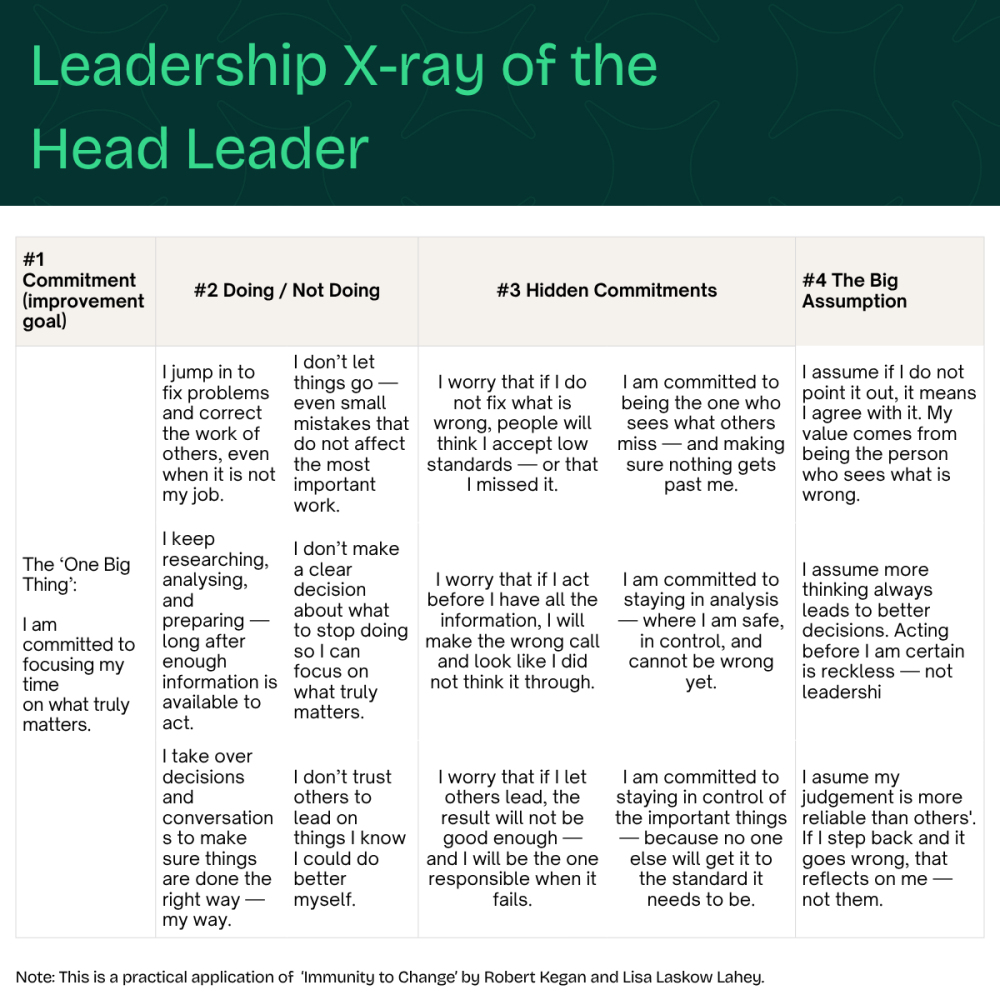
The X-Ray you see above was built around one shared improvement goal. It is the same One Big Thing used across this entire series:
"I am committed to focusing my time on what truly matters."
For the Head leader, that goal is blocked not by busyness or by the need to please others — but by something more subtle. A hidden system built around being the person who sees what others miss. And whose value depends on never being wrong.
The Head leader's big assumption sits underneath everything:
"My value comes from being the person who sees what is wrong. If I do not point it out, it means I agree with it."
That belief drives every behavior in Column 2 of the X-Ray. The jumping in to correct. The analyzing long after there is enough information to act. The leading of decisions to make sure they are done right. Each behavior makes complete sense once you see the assumption underneath it.
But here is what the assumption costs. When your identity is built around being the person who sees what is wrong, then every insight you share is experienced by others as a verdict. Every observation lands as a criticism. Every contribution closes the conversation rather than opening it.
And over time, people stop thinking in your presence. Not because they are incapable. Because there is no space for their thinking to matter.
The most effective developmental step is never a leap to the unknown. It is leaning into what is already there... building on your strengths to become a more purposeful, impactful version of yourself.
For the Head leader, those strengths are genuinely extraordinary. The ability to cut through complexity. To see what others miss. To hold a wider perspective when the room gets emotional. To care deeply about getting things right.
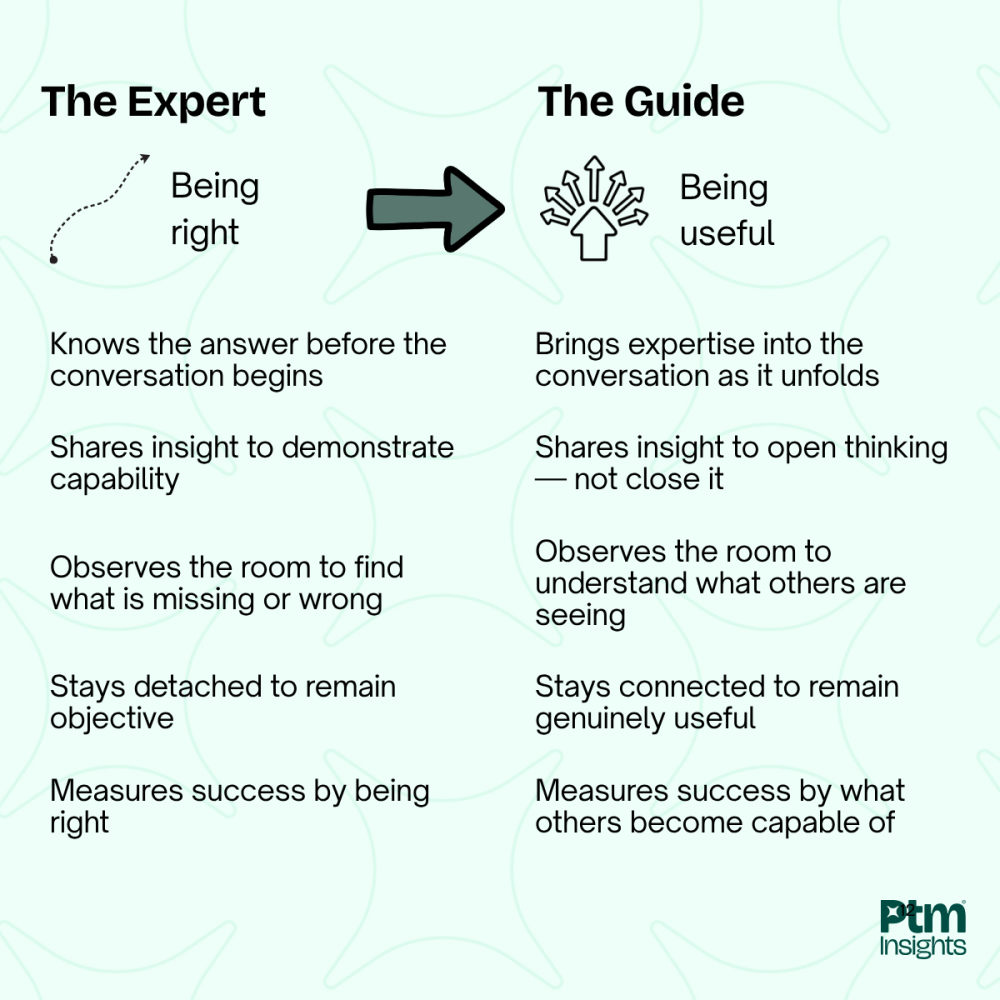
The question is whether those strengths are currently landing as gifts or as verdicts. The shift is from being the person who has the right answer to being the person who creates the right thinking. From Expert to Guide.
The shift is not from knowing to not knowing. It is from delivering the answer to creating the conditions where the best answer can emerge - with your expertise as the catalyst rather than the conclusion.
The question to ask yourself before your next insight:
"What am I trying to create in this conversation: the right answer or the right thinking?"
Then try this. In one upcoming meeting where you already know something others are missing, offer your insight as an observation and a genuine question:
"Here is what I am noticing ... [your insight]. I am curious what others are seeing that I might be missing."
Write the answers down. They are your data.
Most Head leaders find the experiment surprisingly uncomfortable. Not because sharing the insight is hard... but because staying genuinely curious about the response is. The instinct is to evaluate whether others are right or wrong. The experiment asks them to actually be open. And that is different.
What the experiment asks is a specific kind of courage. Not the courage to speak up - they already have that. it is the courage to share thinking before it is fully formed and defended. To be seen as uncertain. To not have the final word.
That thread and what it means for leaders regardless of their type is the subject of my next article.
In my next article I close this series and name the common thread that runs underneath the Willpower, Heart, and Head experiments. Three completely different leaders. Three completely different experiments. One thing they all require.
If this resonated, I would love to hear from you in the comments. And if you are ready to design your own experiment, reach out at diane@ptminsights.com.